How to get your restaurant recommended by ChatGPT and Google AI Overviews
Guide · GEO and AI · · updated · 3 min · by the Renver team
Quick answer
Summary
No AI platform publishes the full list of what it uses to recommend a restaurant. What an owner can control is facts that are complete, consistent and easy to verify — a complete Google profile, specific owner replies to reviews, and a website with the menu, prices and opening hours in structured data. That raises the chance an AI can say something correct about the restaurant. It does not guarantee a mention.
More and more people ask ChatGPT “where can we have dinner with kids in Pinheiros?” — or see a ready-made answer at the top of Google — instead of scrolling a list of links. For a restaurant the question changes. Ranking well is no longer enough: you have to be the answer an AI can put together and justify.
What an AI reads about a restaurant
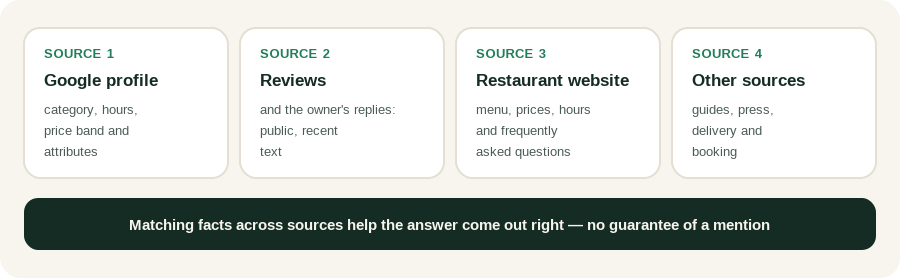
No platform details all of its sources. This list is what is public, verifiable and within an owner's reach.
- The Google Business Profile: category, opening hours, price band, attributes (pet friendly, accessible, vegan options).
- Reviews and the owner's replies — public text, recent, tied to the place, which can be one of the sources.
- The restaurant's website: menu, prices, hours and frequently asked questions, ideally in schema.org markup.
- Mentions elsewhere: guides, press, delivery and booking platforms.
A model does not “like” a restaurant: it assembles an answer from what it can state. Specific facts that match across different sources help the answer come out right, but no platform guarantees that this leads to a mention.
What Google says
For Google's AI search the official guidance is the same as for ordinary SEO: useful, original content and a page Google can crawl. Google says no special markup is needed, and no AI text files such as llms.txt. For local search it describes ranking as relevance, distance and the prominence of the business, and says reviews and helpful replies help a business stand out.
Five practices that keep your facts correct
- Complete your Google profile, including special hours for public holidays (a guide, in Portuguese, written for Brazilian holidays). A wrong opening time is one of the errors that frustrates guests most, and it is easy to avoid.
- Answer reviews regularly and without delay. Google says replying shows you value feedback. There is no minimum percentage to hit: what counts is that each reply is useful to whoever reads it.
- Prefer replies that carry facts over generic ones: the dish, how it is cooked, the neighbourhood, the hours (more in Portuguese). It is more useful to the next guest; an effect on AI is not proven.
- Publish the menu with prices as HTML, not only as a PDF or an image, and, if you like, point to the page in the
menufield of schema.org. - Write a page of real frequently asked questions: parking, booking, gluten-free options, corkage.
What does not work
Stuffing the site with keywords, buying reviews, or asking for a review only from guests who enjoyed themselves — so-called review gating, which Google prohibits (see the guide, in Portuguese). Besides the risk of a penalty, none of it produces new facts, and verifiable facts are the only thing a restaurant really controls.
To find out where you stand today, before you change anything, run the 20-minute test.
See also: Search Console for a restaurant: submitting the page and reading the status.
Sources
Want to look after what AI finds about your restaurant?
Renver keeps the information complete and the same everywhere and, once the data source is connected, measures where the restaurant appears, with no promise of position.
See how it works